
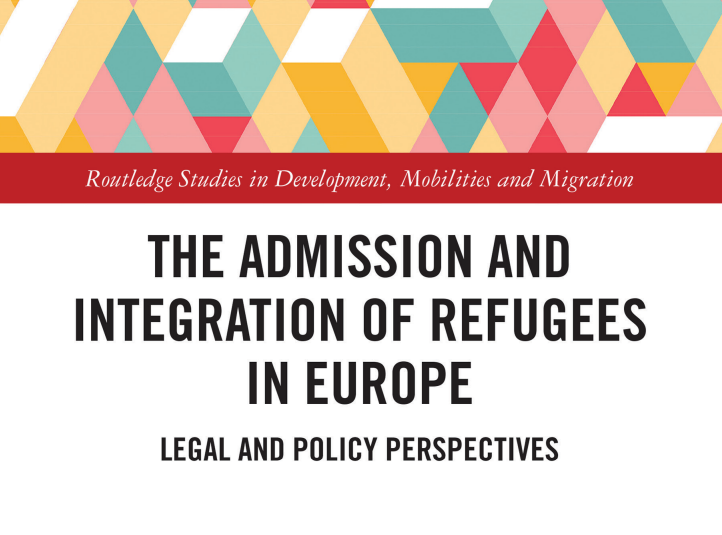
The Netherlands passed two major asylum laws just before the summer to get a tighter grip on migration. Other Western countries also want stricter policies and at the European level, many policy makers are also thinking along these lines. Against this backdrop, Salvo Nicolosi (Utrecht University) and RUNOMI member Giacomo Solano (Radboud University) had the privilege of presenting their new book, The Admission and Integration of Refugees in Europe (co-edited with Sebastian Meyer), at the European Parliament in Brussels. The event, organised by Erik Marquardt and Fanni Bihari, offered an invaluable opportunity to bring research insights directly into the policy arena and to exchange perspectives with Members of the European Parliament, NGO representatives, and fellow researchers.
At the heart of their presentation was a call for a more holistic and interconnected approach to refugee policies. Too often, admission and integration are treated as separate stages: one concerned with legal status, the other with social inclusion. Yet the book shows that they are fundamentally intertwined. The way admission is structured has profound implications for the ability of refugees to integrate—and neglecting this connection risks undermining both individual lives and broader societal outcomes.
Nicolosi and Solano highlighted three key points that emerged from the book:
- EU legislation creates an artificial divide between admission and integration. Current frameworks often focus narrowly on asylum procedures without considering how restrictions imposed at the point of entry—such as limited rights or uncertainty about status—directly shape integration pathways.
- Integration begins from day one. Policies that delay access to work, education, or language support until refugee status is formally granted miss a critical window of opportunity. Asylum seekers are not “on hold” while their cases are processed; they are already part of communities and should be supported accordingly.
- Integration support should go beyond narrow humanitarian or utilitarian approaches. Refugees are not just passive recipients of aid or economic actors, but individuals with diverse experiences, agency, and contributions to offer.
These insights underscore the need to rethink refugee policies (and migration policies more in general), both at the EU level and within member states. Restrictive admission policies and delayed integration measures create unnecessary barriers. They can also fuel exclusion and mistrust. By contrast, early and comprehensive support can foster well-being, trust, and social cohesion, with benefits for both refugees and host societies.
The discussion in Brussels was lively and constructive. Participants engaged deeply with the book’s arguments, raising questions that reflected both the complexity of the issue and the urgency of getting policies right. While translating research into concrete legislative change is always a long process, moments like this shows why dialogue between scholars, policymakers, and civil society is essential. But dialogue alone is not enough—the insights in the book are a call to action, urging us to turn ideas into solutions, and to act now for meaningful change.
For those interested in exploring these issues further, a preview of The Admission and Integration of Refugees in Europe is available below, the full version you can find here: