
This blog was written by Simone Wilke as part of our ongoing blog series written by Radboud master students.
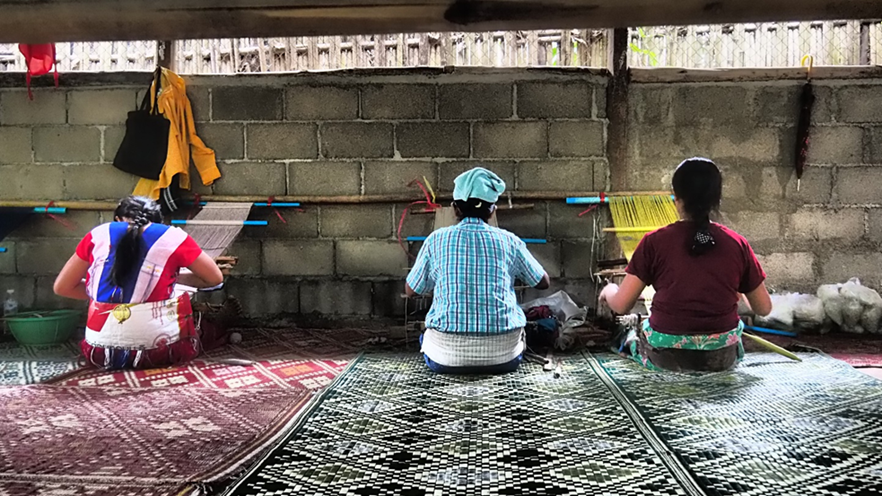
In mid-April 2024, my colleagues from the local NGO WEAVE and I were driving through muddy paths and villages in the North-East of Thailand. Near the border of Myanmar, we would pass a gate guarded by Thai camp guards, marking the entrance of a refugee camp. Here, more than 10.000 people from Myanmar reside. While driving through the camp, I met many people’s eyes and thought about their stories and how they are experiencing their lives living in the camps. In the three months as a volunteer for WEAVE, I had the chance to speak to many women living in the camp, while they were creating fabrics and pieces of clothing by weaving, sewing, and embroidery for themselves, to sell to people they know or to buyers from all over the world through WEAVE.
While volunteering, I conducted fieldwork for my thesis. The main focus of the field work was the willingness to embrace unexpected situations, based on serendipity, or in other words, making ‘unsought findings’. The idea was to find answers to questions that had yet to be formed. This led me to the concept of time as a central theme in the experience of people living in refugee camps. Here, I will describe my field work experience in the refugee camps along the Thai-Burma border by highlighting the dynamics of observation and the concept of time.
The observed and the observed
Field work requires care and constant (re)consideration. Mainly when research is aimed at ‘marginalized groups’, like refugees, concepts like the do no harm principle, (neo)- colonialism, and white saviourism were often named during preparation. Though I was aware of the theoretical meaning of these concepts, the implications of these concepts became apparent to me while in the refugee camps. Its implications unfolded for me personally in feelings of self-doubt and a sense of discomfort through the classical image of being a European white woman from a university, or as a volunteer for an NGO in a refugee camp. Consequently, initially, I felt like an observer, and I tried not to interfere in people’s lives as much as I could.
Nevertheless, over time, I found that I did not want, and could not, be a sole observer. The first reason is that I believed that sole observation equals being there exclusively for self-serving motivations, which I tried to avoid as much as possible. The second reason is that I quickly realized that the idea of me being the only one ‘observing’ is impossible. Participant observation as a research method showed me that the role of observer is easily reversed. Because I do not speak the language and, more generally, because of how I look, there was no doubt that I was not from the area. Walking through the camp where I was ‘taking it all in’, I noticed many people looking. Maybe out of curiosity, or for no reason at all, though it made me feel ‘observed’ in my turn.
During lunches both in the office and in the camp, the women living there and my colleagues showed me what they like to eat and asked me how and what we eat in the Netherlands. Although the example shows general interest that naturally goes both ways in most social situations and interactions. It stood out to me because, while I was carefully and consciously observing, it almost surprised me that they were also sorting out who was in front of them. These examples continued and led to humorous situations as well. While I was greatly impressed by seeing the women weave beautiful shawls, my weaving attempts led to laughter and jokes. Though the observer and observed dynamic seems evident when meeting people or being in a new space, in research, acknowledging the dynamic encloses a crucial part of going beyond looking at researching ‘marginalized groups’ in terms of being mere ‘research objects’.
Time
Time takes a significant role in people’s lives. However, it is safe to say that time is not experienced in the same way. The concept of time became central for both the research content and the methodology itself. Research and writing a thesis are inherently connected to time: deadlines, duration of the field work, and the length of the thesis, for example. Besides the research, the NGO WEAVE had some critical deadlines; some of the woven pieces had to be finished before a specific time, or deadlines for funding and grants had to be met.
For the content, the duration of the women living in a refugee camp, which is set up as ‘a temporary solution’, became one of the main themes. Many women have been living for over 20 years in the designated temporary shelter. This led me to question: ‘how long is temporal?’ and thereby ‘when does one stop being a refugee?’. For me, it was clear that there seemed to be a discrepancy between the long ongoing war in Myanmar and the temporality of refugee shelters on the Thai/Burma border.
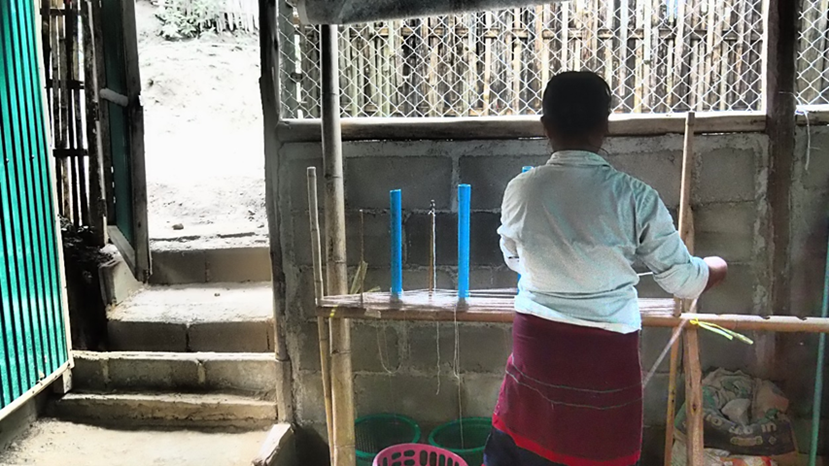
Besides the larger themes, my idea and experience of time as linear, read through clocks and schedules, and for time to be used as efficiently as possible, was also challenged. When I asked one of the women what her age was, she replied that she did not know but knew that she was born during the rainy season. Another example is that it takes days to finish one handmade piece through weaving, sewing, and embroidery – though much more happens during these days than just finishing up a piece of clothing. For example, it is sticking to their weaving tradition while being away from home. Weaving became the central metaphor for describing all the different timelines interwoven and existing together. Time seems central to the experience of life, and in my view, it shows that the concept of time is essential in research on displacement and the experience of refugees. The field work has taught me to be even more conscious of people’s different experiences. Especially through the lens of time, there are many layers, or threads, to uncover.
I want to thank Catherina Wilson for encouraging me along the way to not look for specific answers, but for experience in the broadest sense, for all the feedback, and for showing me how to take a critical stance on myself and research in these contexts in general. I want to thank the crew of WEAVE for granting me ‘access’ and, therefore, the ability to volunteer and do fieldwork, but mostly for welcoming me and being great friends from many miles away.