

We look back on two days of fruitful discussion on the ‘Future of Work’ organized by RUNOMI, IMISCOE, CMR and CESS. The conference was opened by keynote speaker Piotr Lewandowski, funded by CESS, who delivered a presentation titled ‘lessons from the economics of technology for labour migration research’, which set the tone for an exchange between economic-minded researchers and scholars of migration studies. The presentation explored how recent advances in surveys of job tasks and skill use at work improve our knowledge of global differences in job tasks, and their drivers (like technology, globalization, structural change and skill suply). To assess these differences, Mr. Lewandowski discussed an insightful indicator: routine task intensity (RTI). Less routine-intensive work (lower RTI) is associated with higher productivity and earnings. Across the globe, there are significant differences in RTI for the same job. Among ”lower- and middle-skilled” occupations, for example, most differences can be attributed to technology use and supply of workers with the required skills. This analytical lens from labour economics may support inquiries into labour market integration of migrants who often face occupational downgrading or skills waste upon moving.
Continuing this line of debate, during the conference we discussed 10 papers on this topic, divided into three themes: ‘digital skills and adaptation to technological change’, ‘technological transformation of work, migration, regulation and control’ and ‘labour shortages, (skilled) migration and automation’. Digital skills were a prominent topic for Day 1 of the workshop. We raised questions around labour market outcomes of migrants and natives in Europe and discussed the meaning of decent work in an era of technological change. We also moved outside of the European context to examine how digitalization affects informal migrant labour.
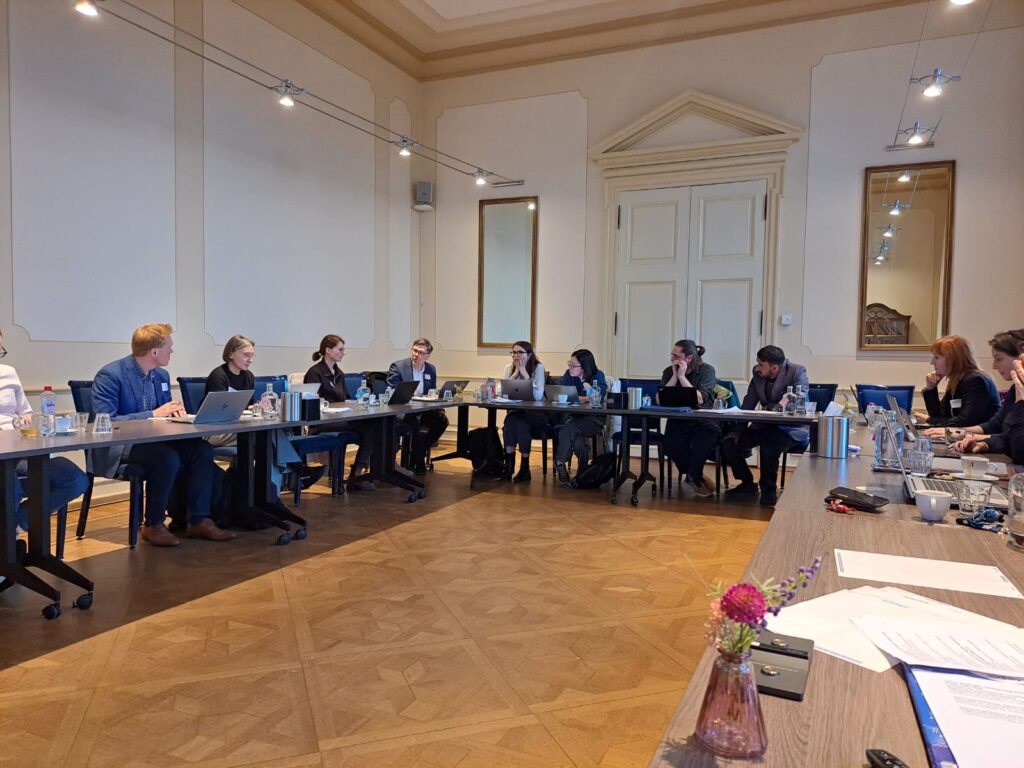
Our second day started with an in-depth dive into papers tackling technological transformation of work, migration, regulation and control. We continued to create bridges in geographic terms, but also enjoyed the variety of theoretical and methodological approaches. On this occassion, our exchange ended with one intersection of migration, education and labour market policies: the topic of skills shortages, perceived lack of workers with required skills in a sector/occupation. Researchers from the Horizon Europe project ”Global Strategy for Skills, Migration and Development” presented studies on effects of automation on migrant workers in Austria, and a recently completed survey of employers’ strategies to address skills shortages in four European countires. The central theme ‘Future of Work’ allowed for a broad application from digital skills, automation, labour gaps, to the technological transformation of production and increased control of (migrant) works with use of technology taking us from migrant street vendors in Kashmir to Ukrainian migrants in the EU.
With participants from all over Europe and beyond, and participants online, we had a rich discussion about the ever-changing environment of work and migration with perspectives from multiple disciplines. We thank everyone for coming and being part of our conference on the Future of Work. We thank IMISCOE and CSES in particular for help funding the event, and we look forward to what comes next.


